When investing in cup filling and sealing equipment for your food manufacturing operation, one of the most important decisions you'll face is choosing between rotary filling machines and inline (straight-line) filling machines. Both systems have distinct advantages, and the right choice depends on your specific production requirements, product characteristics, and facility constraints.
In this comprehensive guide, we'll break down the key differences between these two types of filling machines to help you make an informed decision for your packaging line.
What Is a Rotary Filling Machine?
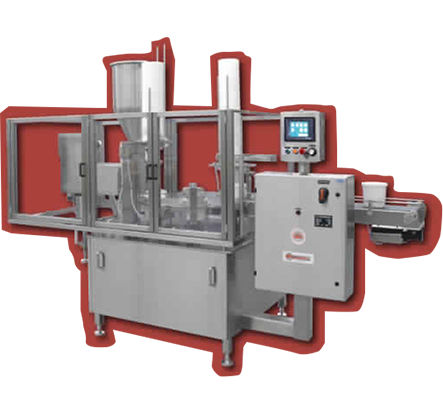
A rotary cup filling machine uses a circular carousel design where containers move in a continuous rotational motion through filling, sealing, and overcapping stations. Multiple operations occur simultaneously as containers progress around the carousel, making these machines ideal for high-volume production environments.
Key Features of Rotary Fillers:
- High-speed operation - Capable of filling up to 320+ cups per minute
- Continuous motion - Containers never stop moving, maximizing throughput
- Multiple filling heads - Several containers are filled simultaneously
- Compact footprint relative to output - More production in less floor space
- Integrated operations - Filling, sealing, and overcapping in one unit
What Is an Inline (Straight-Line) Filling Machine?
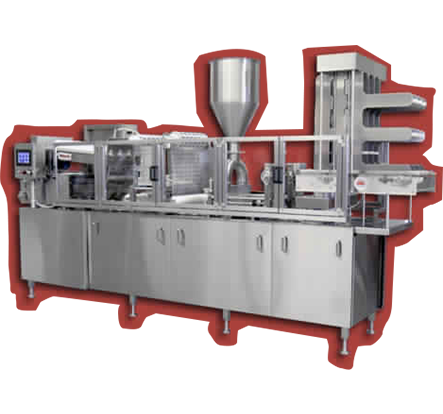
An inline filling machine, also called a straight-line filler, moves containers in a linear path through sequential stations. Containers typically index (start and stop) at each station for filling, sealing, and other operations. This design offers greater flexibility and is often preferred for varied production runs.
Key Features of Inline Fillers:
- Flexible configuration - Easily adapt to different container sizes and products
- Quick changeovers - Faster transitions between product runs
- Lower initial investment - Generally more affordable than rotary systems
- Easier maintenance - Simpler mechanical design with better accessibility
- Scalable - Can add lanes or stations as production grows
Side-by-Side Comparison
| Factor | Rotary Machines | Inline Machines |
|---|---|---|
| Production Speed | High (100-320+ cups/min) | Low to Medium (20-120 cups/min) |
| Best For | High-volume, single product runs | Varied products, frequent changeovers |
| Initial Cost | Higher investment | Lower investment |
| Changeover Time | Longer (30-60+ minutes) | Shorter (10-30 minutes) |
| Floor Space | Compact for output | Linear, requires more length |
| Maintenance | More complex | Simpler, easier access |
| Flexibility | Less flexible | Highly flexible |
When to Choose a Rotary Filling Machine
Rotary fillers are the optimal choice when:
- Your production volume exceeds 100 cups per minute
- You run the same product and container for extended periods
- You need to maximize output in limited floor space
- Your product is a single viscosity (liquid, semi-viscous, or viscous)
- You have dedicated lines for specific products (e.g., yogurt, sour cream)
Industry Example
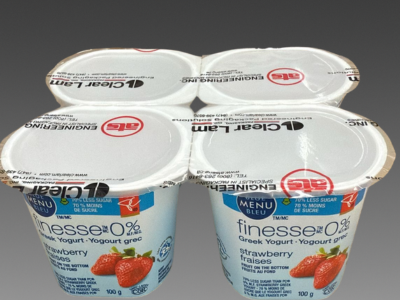
A large dairy processor producing 500,000 cups of yogurt daily would benefit from a rotary system's high throughput and efficiency. The higher initial investment is quickly offset by lower cost-per-unit and faster ROI.
When to Choose an Inline Filling Machine
Inline fillers are the better choice when:
- Your production volume is under 100 cups per minute
- You frequently switch between different products or container sizes
- You're a contract packager serving multiple clients
- Budget constraints limit your initial capital investment
- You're a growing company that needs scalable equipment
- Your facility has more length than width available
Product Considerations
The type of product you're filling also influences your machine choice:
For Liquid Products (Juices, Milk, Thin Sauces)
Both rotary and inline machines handle liquid products well. For high volumes, rotary is more efficient. For varied liquid products, inline offers better flexibility.
For Viscous Products (Yogurt, Sour Cream, Hummus)
Viscous products require positive displacement filling systems. Rotary machines can achieve higher speeds with viscous products, but inline machines offer easier cleaning between product changeovers.
For Particulate Products (Deli Salads, Cottage Cheese)
Products with chunks or particles require special filling systems that don't damage the product. Inline machines often provide gentler handling, but rotary systems can be configured for particulates with the right filling technology.
Making Your Decision
The choice between rotary and inline filling machines isn't about which is "better" - it's about which is better for your specific situation. Consider these questions:
- What is your current production volume, and what do you project for 5 years?
- How many different products and container sizes will you run?
- How often will you need to change over between products?
- What is your available floor space and layout?
- What is your capital budget for equipment?
- Do you have maintenance staff capable of servicing complex machinery?
Get Expert Guidance
At A.T.S. Engineering, we've been designing and manufacturing both rotary and inline filling machines for over 30 years. We understand that every production environment is unique, and we take the time to understand your specific requirements before recommending a solution.
Whether you need a high-speed rotary system for your dairy line or a flexible inline machine for contract packaging, our engineering team can help you find the right fit for your operation.
Ready to Discuss Your Project?
Contact our team for a free consultation. We'll analyze your production requirements and recommend the optimal filling solution for your business.